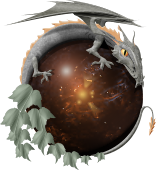
An Orc-chieftain of Mount Gram, who took part in the raiding of Eriador, starting in the year III 2740. He must have ranged far westward from his mountain home,2 for it was not until seven years later, in III 2747, that his band of marauding Orcs found and crossed the river Baranduin. Thus they found their way into the Northfarthing of the Shire.
At a place named Greenfields, Golfimbul and his Orcs met a determined resistance raised by the native Hobbits. The Shire-hobbits were not a naturally war-like people, but these defenders were led by Bandobras Took, called the Bullroarer, who was one of the largest and strongest Hobbits in history. We have few specific details of the battle that followed, except that the Bullroarer led a charge against the Orcs, and with a wooden club he swept Golfimbul's head from his shoulders.3 If the Orcs made any further incursions into the lands of the Shire after this Golfimbul's defeat, they are not recorded.
Notes
1 |
Golfimbul's name is something of a hybrid. In early drafts of The Hobbit, Tolkien borrowed the name Fingolfin for him from the Silmarillion tradition. Meanwhile, the character who would become Thrór was originally known as Fimbulfambi (from the Old Norse for 'great fool'). As the story developed, elements of these names merged together, so Golfimbul inherited the Golf- from 'Fingolfin' and the -fimbul ('great') from 'Fimbulfambi', creating a compound name without any specific meaning. |
2 |
At least, Golfimbul presumably ranged westward, though in fact we are never told specifically where his Orc-hold of Mount Gram was located. However, it is known that the Orcs invaded Eriador at this time, so Mount Gram must have been outside Eriador's borders. This would only realistically place it somewhere in the northern Misty Mountains (or just possibly in the Grey Mountains where the two ranges met).
|
3 |
The full account of this skirmish (in The Hobbit 1, An Unexpected Party) goes a little further into the details of the event, claiming that Golfimbul's head travelled a hundred yards through the air and landed in a rabbit hole. The narrator there claims that thus the game of golf was invented, taking its name from Golfimbul.
This is obviously meant as a whimsical aside, and is surely not to be taken too seriously, though it may not be completely fanciful. Even at the end of the Third Age, nearly three hundred years after Golfimbul's defeat, the Shire-folk still remembered the encounter as the Battle of Greenfields. So, it is not entirely implausible that they might have remembered that famous victory by devising some kind of golf-like game in imitation of Bandobras Took's mighty swing of his club. If such a game existed, it would not - of course - have been called 'golf'. (The true origins of the name 'golf' are not absolutely established, though it seems to come from old Scots gouf, 'club', rather than the name of a Goblin raider.)
|
Indexes:
About this entry:
- Updated 8 February 2026
- This entry is complete
For acknowledgements and references, see the Disclaimer & Bibliography page.
Original content © copyright Mark Fisher 2002, 2009, 2026. All rights reserved. For conditions of reuse, see the Site FAQ.
Website services kindly sponsored by Axiom Discovery aptitude and skill testing.
Axiom Discovery gives you comprehensive online aptitude testing covering core skills across a wide range of disciplines.