The Encyclopedia of Arda - an interactive guide to the world of J.R.R. Tolkien
Dates
Probably1 destroyed at the end of the First Age
Location
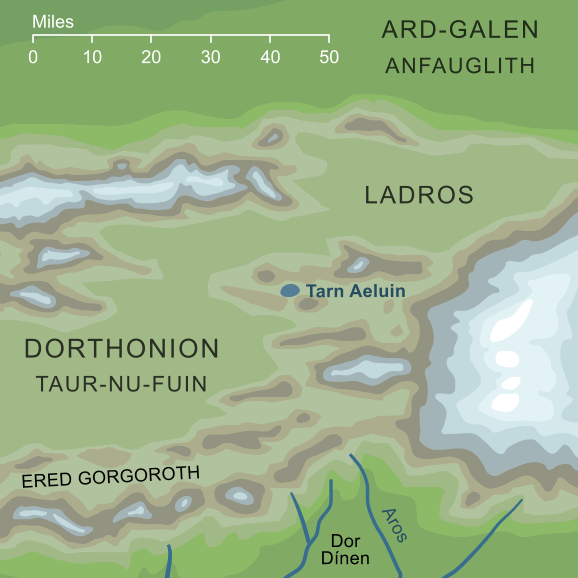
On the southwestern borders of Ladros in eastern Dorthonion (later called Taur-nu-Fuin)
Origins
Said to have been hallowed by Melian in ancient times
Race
Division
Culture
Family
Within the lands of the House of Bëor
Pronunciation
ta'rn ae'luin ('ae' is pronounced like English 'eye')
Meaning
A 'tarn' is a mountain lake;2 Aeluin probably means 'blue lake'3

Indexes:

About this entry:

  • Updated 22 February 2026
  • This entry is complete

Tarn Aeluin

The refuge of Barahir

Map of Tarn Aeluin

In the high windswept moors of Ladros, to the east of Dorthonion, was the clear mountain lake of Tarn Aeluin. Lying among moorland of heather and whin, the lake's surface shone a pure blue by day, and by night it mirrored the stars in its darkened surface. Around this tarn grew stands of silver birch and alder, and rocks thrust up out of the moorlands like standing stones.4

In the distant past, before even the Elves had come to Beleriand, the Maia Melian would travel there at times, and the high tarn was said to have been hallowed by her. Its blessed waters shone uncorrupted for many thousands of years and when Men settled in Ladros long afterward, they held the pool in reverence, and none dwelt beside its shores.

Those Men were Edain, descendants of the House of Bëor, who settled in Ladros as vassals of Finrod Felagund. They held that fief until the Dagor Bragollach of I 455, when the defences of Dorthonion were overwhelmed by the forces of Morgoth. A handful of survivors, led by Barahir, hid themselves on the shores of the hallowed tarn, which lay in the southwestern heights of Ladros. Thus Aeluin became the refuge of Barahir and his outlaws as they resisted the occupiers of their former home.

For a time the outlaws dwelt in secret by the lake, but one of their number, Gorlim, was beguiled by Sauron into betraying their hiding place, and then slain. As Sauron's hunters descended on Aeluin, Barahir's son Beren was away from the camp, and Gorlim's spirit sent him a warning in a dream.5 Hurrying back to Tarn Aeluin, Beren found he was too late, and Melian's blessing had not been sufficient to protect Barahir and his people. Beren buried his slain companions, and then set out from Aeluin to follow his own path, which would lead him to became one of the great heroes of the histories of Beleriand.

A little more than a century later, much of Beleriand was drowned under the Great Sea as the First Age came to an end, but Aeluin and its surrounding lands seem to have survived. Following the inundation of that time, the rugged highlands of Dorthonion became a broad island known as Tol Fuin. This island contained the landscape that had held Tarn Aeluin, so the lake may have continued to exist into the later ages on the new island, far off the coasts of Lindon.


Notes

1

Almost all the lands westward of the Blue Mountains were destroyed in the cataclysm of the War of Wrath, but certain isolated highlands survived as islands. We know that this is true of the heights of Dorthonion, which in later ages formed an island off the western coasts of Middle-earth named Tol Fuin. It's possible, therefore, that Tarn Aeluin also survived, and perhaps in later ages continued to exist on the new island in the Great Sea.

2

The word 'tarn' is English, not Elvish. It's a relatively rare word for a mountain lake, especially a small one, so the name 'Tarn Aeluin' is essentially equivalent to 'Lake Aeluin'.

3

The name Aeluin is never explained, but it seems to be derived from the root ay-, meaning 'lake' or 'pool', combined with luin, 'blue'. This is supported by the fact that the lake's waters are described as being 'clear and blue' (in Quenta Silmarillion 19, Of Beren and Lúthien).

4

The canonical works give us little physical detail about Aeluin and its surroundings. The description given here is taken from a brief poetic passage titled Of Tarn Aeluin the Blessed, an experimental addition to the The Lay of Leithian reproduced in the Appendix to Beren and Lúthien.

5

In Beren's dream, he saw the ghost of Gorlim as a form that came to him 'across the water' (Quenta Silmarillion 19, Of Beren and Lúthien). This 'water' in Beren's dream is not identified, but realistically it is hard to interpret it as anything other than a vision of Tarn Aeluin.

Indexes:

About this entry:

  • Updated 22 February 2026
  • This entry is complete

For acknowledgements and references, see the Disclaimer & Bibliography page.

Original content © copyright Mark Fisher 1998, 2001, 2013, 2019, 2026. All rights reserved. For conditions of reuse, see the Site FAQ.

Website services kindly sponsored by Discus from Axiom Software Ltd.
What's inside a Discus personality report? Find out how can help you choose the very best candidates!
The Encyclopedia of Arda
Menu
Homepage Search Latest Entries and Updates Random Entry